
Mark Harrison MBE
NationalSearch Adviser
Homidde, Missing Persons, Mass Fataliiy Disasters
Madeleine McCann Search
PD Luz Beach & Marine
Assessment
The reconnaissance undertaken and this report have been completed at the
direct request and benefit of Guillhermino Encarnacao the Algarve regional
director of the Portuguese Judicial Police.
Personal Profile
I am a serving police officer and the National Adviser in relation to Search for
Police agencies within the United Kingdom. My role involves advising on
searching for persons that are missing, abducted or murdered, using
enhanced search techniques and technologies. I attend and review cases
providing advice and support on search plans, strategies and resources. I
have extensive national and interactional experience in such casework and in
2004 was awarded an MBE for services to search. I am a visiting Professor of
Earth and Ocean Sciences at the University of Southampton.
Prologue
In compiling this report I have walked around the relevant areas of Praia Da
Luz during the hours of darkness and then during daylight hours of high and
low tide. I have concluded reconnaissance flights using the Civil defence
helicopter. On 30/7/07a full site assessment of beach dynamics and a
digability study was conducted by me along with Professors Alveirhino Dias
and Oscar Ferreira costa1 and marine dynamics experts. Additional
consultation has been made with Dr. Jorge Goncalves, a marine biologist.
These named experts all work at the FCMA (oceanographic centre) University
of Algarve.
Report Aim
‘This report solely considers the smmh scenario that Madeline McCann
has been murdered and her body is concealed on the beach at PD Luz or
has been put into the sea from the shore.
The report considers the viability of burial on the beach and the likely
movement of a body if it entered the sea. It also considers the likely incident
of such a disposal choice and any local impact factors that make this a more
or less likely event with the aim to inform decisions on any searches.
Praia Da Luz Beach.
In simple terms the beach is in a natural inlet and bounded by cliffs.
The winds are generally from the west and create low energy waves of less
than 2m. This is significant regarding any body disposal scenario from the
shore as the wave energy is not sufficient to “take a body” out to sea. Instead
a body would most likely trave1 eastwards in a re circulating motion along the
shoreline until it was trapped by the rock outcrop to the east of the beach or
consumed by marine life. ti the entry point was the rock outcrop itself to the
east of the beach then the body would most likely continue in a re circulating
motion along the shoreline until it again encountered a bamer to its passage,
the most eastward of this would be 5km away at Ponta Da Piedade near
Lagos.
Sub Surface Burial on P D Luz Beach
For Body Disposal Purposes The Beach Can Be Separated And
Discussed Into 6 Areas.
Figure 2.The boulders in the rock falls are too large
to man handle. Vegetative growth suggests rock
falls have been in situ for some time. The low energy
wave action would not move any of the boulders. It
is possible a small child could be secreted amongst
the rocks in natural voids.
Figure 3.The cliff edge at the base of the beach is at
an angle that inhibits soil removal. The shale re fills
any hole dug and is unsuitable to achieve a burial.
Figure4.At the base of the cliff are wave cuts where
the bedrock has been eroded by wave action. Here
sand can be easily dug but after a few centimetres
the digger reaches the bed rock, preventing a
successful burial.
Figure 5.The beach cusps or berms are mounds of
sand made by wind action. These cusps form at the
limit of the tides reach and would only be recovered
in storm conditions. Digging on the cusps is easy but to achieve as
more than a few centimetres depth is very difficult to
the fine sand granules refill the hole
Figure 6.The dark sand in this image shows the
intertidal area. Here digging and burial could
possibly be achieved although it would be through a
mixture of grave1 and water. However any burial
would be quickly exposed by wave action and
ultimately taken into the sea.
Tidal Wave Data
Tidal data for the area of Praia Da Luz has been obtained from the buoy near
Faro. It collects data on wave height and diredion. However on 3* May 2007
the buoy malfunctioned and stopped collecting data for the month of May.
Data is available before and after this period and it could be inferred that
these results are consistent with the missing relevant period as there were no
exceptional storm events.
On the 2″d May 2007 the waves were of middle energy of a 2m height and a
easterly drift. When data was next collected on the 22″6May 2007 they were
now low energy waves of 0.5m to I’m with the same easterly winds.
Low tide on the night of the 3* May 2007 was at 2200hrs at 2m. The
maximum amount of beach would be accessible including the rocky outcrop.
High tide on the 4n May 2007 was at 0415hrs at 3.1 m. This would mean that
from 0200hrs onwards half the eastern part of the beach would be submerged
and so access to the rocky outcrop impossible on foot.
Therefore if someone deposited a body into the sea, on the night of M
McCann’s disappearance, from the beach the optimum time window for full
access to the whole beach and rocky outcrop was between 2200hrs and
0200hrs. This time window would also be the optimum time for burial in the
sand, not withstanding the digability study limitations previously described.
The optimum time to throw a body from the top of the diff into the sea would
be between 0200hrs and 0400hrs as the sea would be at the cliffs edge.
Conversely this would not be the optimum time window for a beach burial.
Marine Life
In relation to a body disposal scenario crustations could begin eating within a
few hours if the body was not initially buoyant or trapped on the sea bed. If it
was buoyant then crustations would be joined by fish and crabs once the
decomposition process had begun.
Homicide Disposal Datasets
A limited search has been conducted of datasets that contain body disposal
data in homicide cases (CATCHEM, SCAS, FBI). Although this search was
limited due to the time constraints placed on this reports delivery an inference
can be gained from both the data sets and the authors own case work
experience. I have also consulted with NPIA and FBI colleagues to benefit
from their experiences.
The conclusion inferred is that beach burial is extremely rare. This should not
surprise us as to dig on a beach is a high risk activity requiring expending time
and energy when a more ‘least effort” disposal is readily available, that is
directly into the sea. Of those limited cases that were found to be a beach
disposal the overwhelming majority were surface depositions with only one
recorded concealment using rocks on top of a 2 year old child (CATCHEM
Database)
Discussion
Where a homicide occurs and the sea is accessible and nearby then it would
become a natural disposal choice for an offender using the “least effort
principlen. The beach itself would appear to merely be the platform to facilitate
this. When this is considered in relation to the beach at Praia Da Luz there is
a reinforcement of this view due to the severe limiting and inhibiting factors to
achieve a beach burial there. If a burial was achieved there is a significant
likelihood, based on the tidal coverage of the entire beach, that a burial would
be exposed and or taken into the sea. If a body entered the sea it could
remain close to the shore travelling in an eastward direction until it returned to
shore or became trapped in the sub surface rocks.
The optimum time window, on the night of disappearance, to dispose of a
body into the sea from the shore would have been between 2200hrs and
0200hrs. The optimum time to dispose of a body into the sea from the top of
the cliffs would have been between 0200hrs and 041 Shrs.
Due to the normal high occupancy tourist activity on the beach and in the sea
it could be considered a body would self expose and be detected.
In conclusion there is no intelligence spe?ic to this case or generic datasets
that support a scenario of beach burial. Additionally the digability study and
coastal dynamics of the Praia Da Luz beach further limit this as a viable
scenario. However should further assurance be required I would suggest a
limited inspection around the rock falls at the base of the cliffs’ on the beach
and the waters around the rocky outcrop to the east of the beach.
Should the investigators wish to discuss and develop the issues raised in this
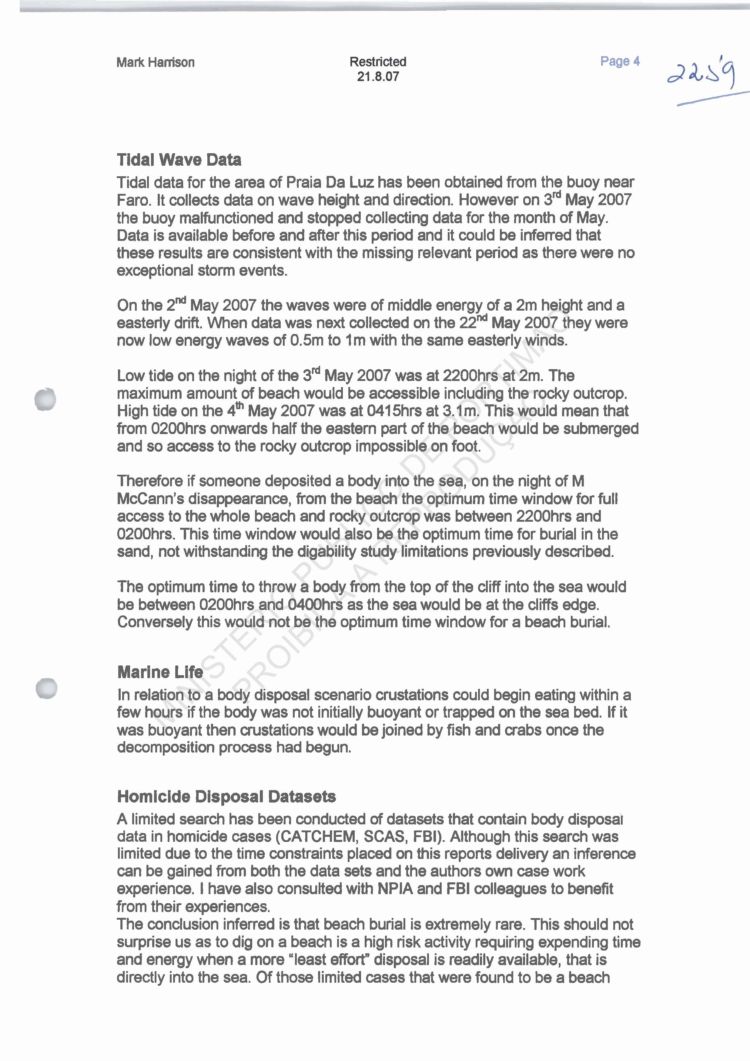
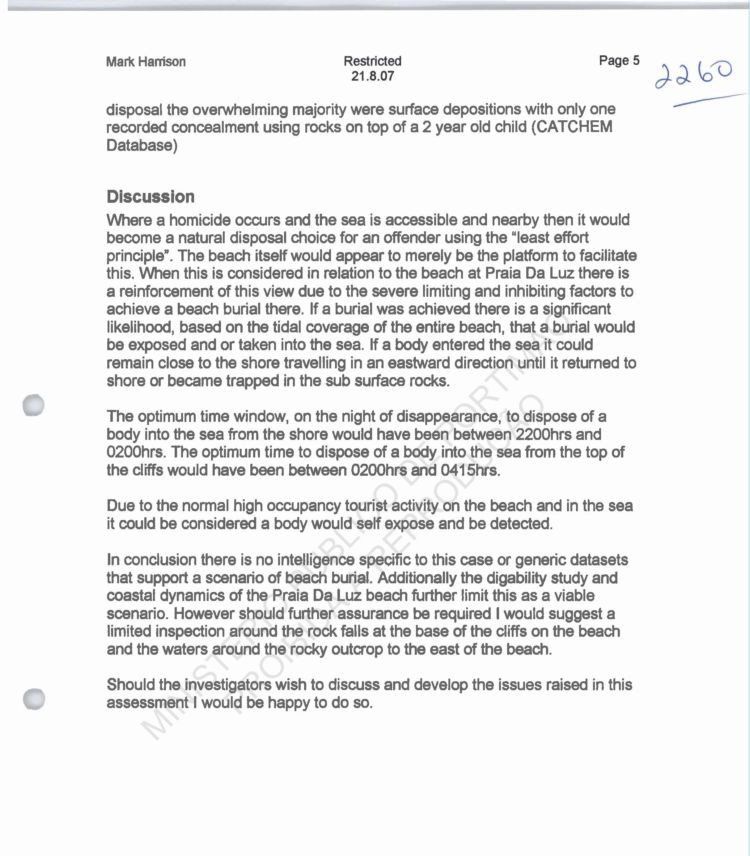
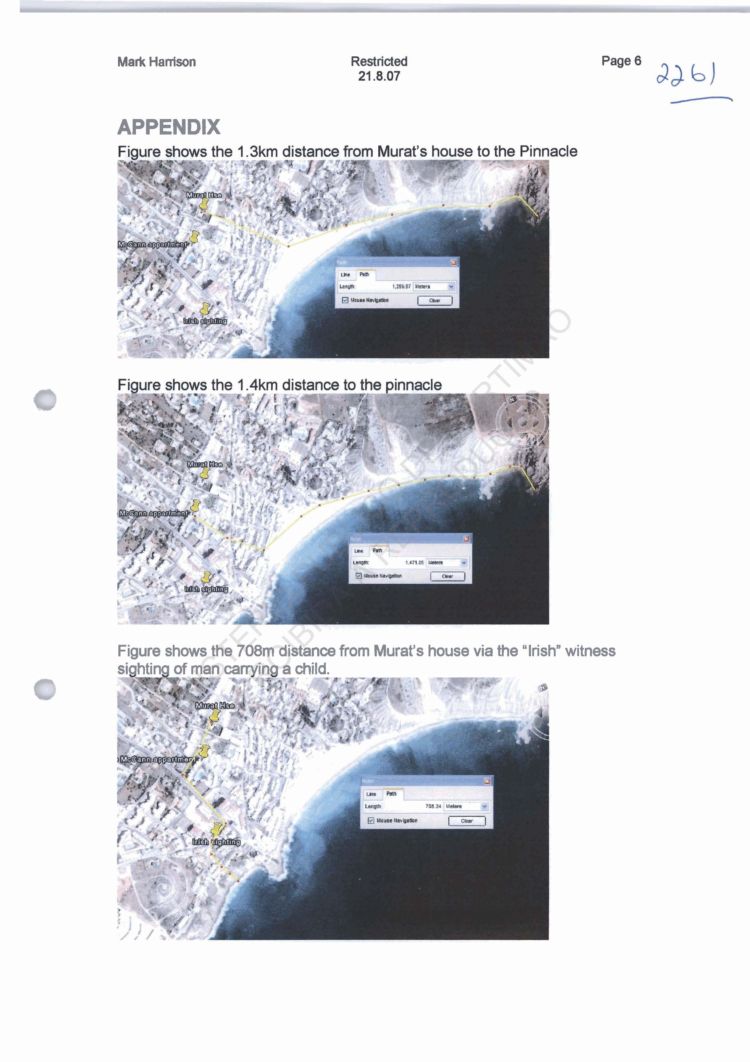
assessment I would be happy to do so.