
‘Information about search procedures
carried out at Casa Liliana
Having in view the recovery of items tending to complement the investigation
running under the above NUIPC, which investigates specifically the disappearance
of the English child Madeleine McCann, the performance of some external inquiry
work was ordered by superiors.
— To do this an investigation team was built comprising [composed of] the undersigned
and colleagues Marques B. and Santos M., all Inspectors, which [team] revealed
[detected] the following result:
Action 1 [Operation 1]
About 10h30 yesterday (16 May 2007) a Portuguese citizen, born 1975, currently
living in Spain, Mr Valdemiro Alexandre M. do C. was personally approached in
Vila de Aljezur where he was holidaying in the family home at Rua 25 de
Abril … in Aljezur.
— In the perspective of a useful collaboration relating to the facts sought in
[the target of] the investigation, the above person came to state that he worked
at times in a company of distribution and support/maintenance, at home, of
electrical household appliances [‘white goods’]. Having seen and heard in the
media references to the home of suspect Robert Murat, residence named as “Casa
Liliana”, he had the idea that he had been there once, about 5 years ago, to
provide support for a washing machine in the kitchen. As he recalls when the work
was done, the home owner went outside to a place with large trees, having opened
a cover [lid] at floor-level, covered by grass, from which she pulled a bottle
of wine that she offered to him. While he recalled this event, he thought that
that place could serve to hold captive the small “Maddie”.
— Conversing “in loco”, it resulted [transpired] that Mr Valdemiro was not
completely certain of it having been “Casa Liliana”. Asked if he could remember
the space in the house where he performed his work he stated that the kitchen
had been medium-sized, estimating by example the place in which we were
[standing/speaking], about 20 square-metres in area, long and narrow in shape.
He stated that the house had a swimming pool which was visible through a window
from inside the kitchen. Further, that at the time he did that work he was using
a Mercedes Vito or Sprinter which, due to its size, could not get through the
gate of the house. Faced with these indications the investigation team there
present, all exceedingly knowledgeable about the interior and exterior of the
Murat residence, had no doubt in understanding that Mr Valdemiro could not have
been referring to this house but to some other where he rendered a service, of
which, according to him, there were many. In truth it is impossible to see the
pool from the house of suspect Robert Murat through a kitchen window, given that
they are situated at opposite extremes. The only kitchen window that faces the
outside is situated above the kitchen counter and the only possible thing to be
seen is a patio, paved with Portuguese paving-stones, that serves as a car park
inside the property. Contrary to what Mr Valdemiro said, there are no trees of
large dimensions but only garden beds with small bushes. The dimension of the
Casa Liliana gate, to the naked eye, would give access to any light motor
vehicle and to heavy vehicles of low tonnage. In order to allow Mr Valdemiro to
immediately communicate any additional information on this matter, he was given
contact numbers for the PJ DIC Portimao, he being able to be contacted at any
time on 961… or 913… (brother), for additional clarifications.
Action 2 [Operation 2]
About 19h00 the same team went to meet Mr Taylor, an English Civil Engineer,
responsible for the original design of “Casa Liliana”, and having been present
at all times during its construction.
— This work had the objective of collecting information about the existence of
a trap-door giving access to an “empty” area below the house, as well as the
existence of any buried/underground features.
— Next to the home of Mr Taylor, better identified as Desmond William Taylor,
born 1929, permanent resident holding a UK passport, situated at Quinta do
Pinhal … Bispo, in conversation with him it was possible to determine the
following:
— He, from memory and given that it had been the last house he had designed
and built, he had drawn a “sketch” to provide a more concrete idea about the
house in question. Having analysed that document and compared it with the
official plan [blueprint] obtained during the investigation, there appeared to
be no significant difference worthy of remark. It was determined that the house
is built on very uneven ground, having been adapted through movement of earth,
removing earth from above and construction of a supporting wall, followed by a
‘hole’ covered with beams and supports in the lower part, creating an “empty”
space below the house extending the entire area of the lounge up to the outside
passage that borders the house. That “empty” space could have a maximum drop of
1,5 metres. During the construction access was maintained into this space, by
withholding a small number of supports, with a view to running all the plumbing
and drainage under the house, as was done. At the end of the work and after the
owner was asked if he wanted to keep that access or close it up permanently, the
owner opted for the second idea, the access then having been closed up with
large bricks. Mr Taylor stated that there was no other way into the space As for
septic tanks, Mr Taylor said the only one, in fibreglass, is nearby the pool
covered by earth. The highest part of it could be about 0,5 metres below ground.
From memory that tank was located in the area to the front of the bedroom
currently used by the mother of suspect RM, very close to the two water cisterns
adjacent to the pool which were built to collect and contain rainwater, with the
objective of optimizing the water usage [irrigation/watering] of the property.
The contact number 282… was furnished for any [further] useful clarification.
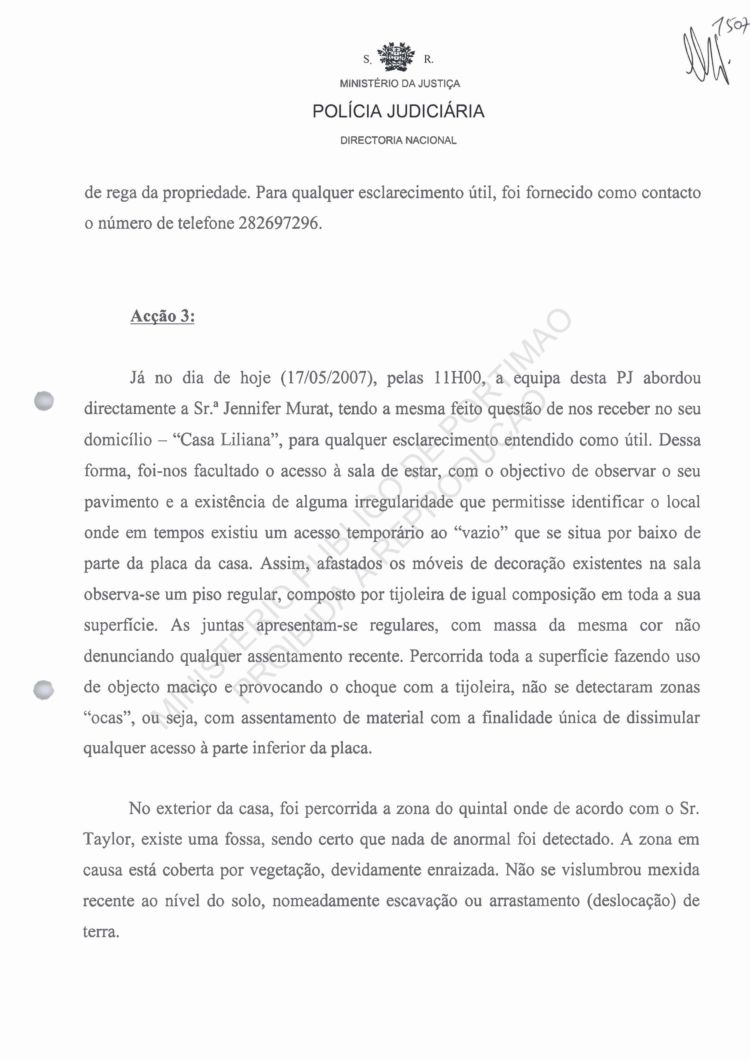
Action 3 [Operation 3]
Already today (17 May 2007), at 11h00, this team approached directly Mrs
J.Murat, who asked us into her home – Casa Liliana, for some clarification
understood to be useful. In that way, she gave us access to her main living room
for us to examine the floor covering and any irregularity that might indicate
where once existed the temporary access to the “empty” space beneath that part
of the house. All furniture being moved aside it was observed a regular floor,
made of large brick [tile] of equal composition across the whole surface. The
joints all appeared normal, with grouting the same colour indicating no recent
placement. The entire surface area was covered using a ground-penetrating radar
device without detecting any “hollows”, that is, material placed beneath the
floor dissimilar from surrounding material.
— Outside the house the kitchen garden was examined looking for evidence of
the septic tank, nothing abnormal was detected. That area is covered by
vegetation firmly rooted. No disturbance of the soil of any kind was observed.
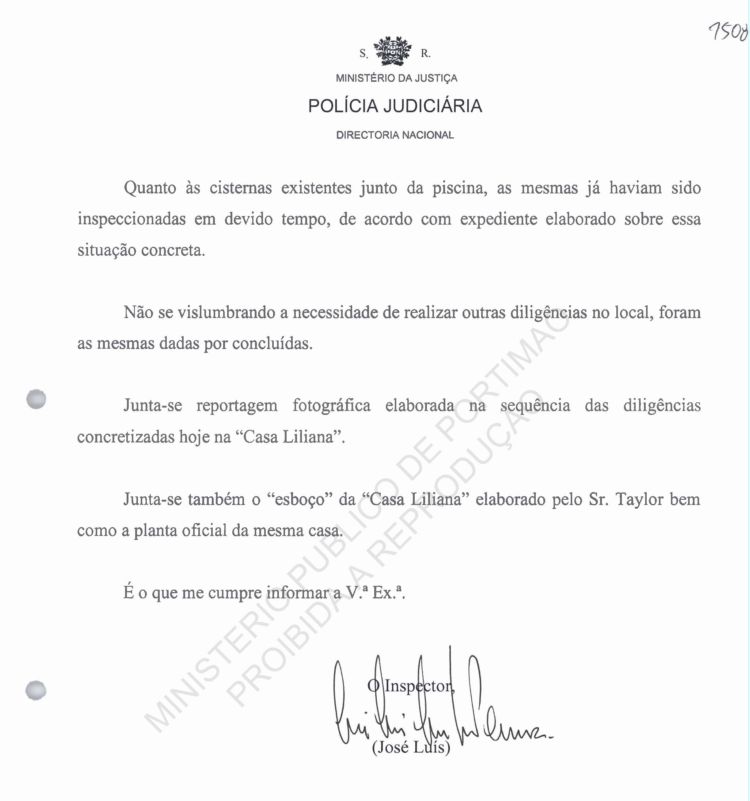
While the cisterns exist next to the pool they had already been inspected
according to the document prepared on that work.
Not seeing the need for any further work in the place, this work was concluded.
Attached is the photographic report prepared during the work done at “Casa
Liliana”.
Also attached is the “sketch” prepared by Mr Taylor along with the official
building plan.
Processos Vol VI Pages 1509 to 1516
Photographic Report of Search at Casa Liliana